Archives by date

You are browsing the site archives by date.

BOSU for Sports Conditioning: What Transfers to Your Sport?

BOSU for Sports Conditioning: What Transfers to Your Sport?

Getting better at balancing on a BOSU does not automatically improve your golf swing, running speed, or ability to change direction in a game. A sport has specific demands, and a useful conditioning plan needs to explain how an exercise relates to them.

The BOSU may be one accessory in a broader program. It should not replace practicing the sport, developing appropriate strength, or building the conditioning needed to participate.

Separate Four Different Training Jobs

Skill practice develops the actual sporting task, such as striking a ball or controlling a movement in play. Strength work challenges the muscles against an appropriate resistance. Conditioning prepares you for the activity’s effort and duration. Balance practice focuses on controlling a position or movement.

These areas can interact, but an exercise does not train all of them equally just because it is difficult. Ask which job the exercise is supposed to do and how progress will be measured.

What the Research Can—and Cannot—Tell You

A 2015 systematic review found limited additional benefits when unstable-surface training was compared with stable-surface training in healthy adolescents and young adults. Findings differed across outcomes and populations, and study quality was a limitation.

That does not mean balance equipment is useless. It does mean that instability alone is not a reason to promise better athletic performance. A training decision should be tied to the person’s actual task and needs.

A Recreational Golf Example

A golfer who becomes tired while walking a course might discuss a manageable walking and conditioning plan. Someone who wants help with swing technique should work on that skill with an appropriate golf instructor. General resistance exercise may be another part of the broader plan.

A BOSU drill cannot establish which of those needs is most important. Swinging a club while standing on an unstable device also changes the task from swinging on the course. This article does not recommend using that setup as a shortcut to a better swing.

A Field-Sport Example

An athlete may need to practice acceleration, stopping, or changing direction in an appropriate environment. Their coach should consider the athlete’s experience, current workload, season, and any rehabilitation restrictions.

Rapid shuffling across a dome is not automatically a substitute for that practice. Nor does successfully catching a ball while balancing prove that a previous injury is ready for unrestricted play. Return-to-sport decisions require the relevant healthcare and coaching input.

Where a BOSU Could Fit

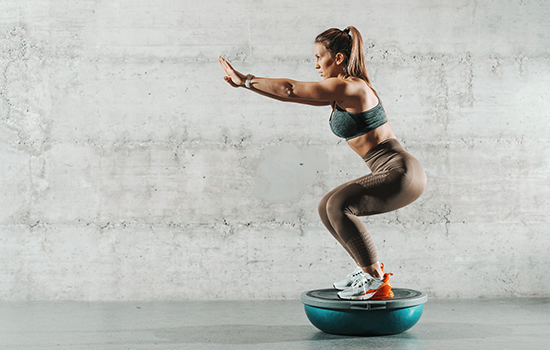
A coach-selected, controlled balance task could have a limited accessory role when it addresses a specific need. Keep it separate from tasks that demand equipment handling or rapid movement you cannot control. It is reasonable to choose stable-ground balance work instead.

BOSU does not recommend standing on its hard platform side. Follow the product instructions, use an appropriate support, and leave enough clear space. Adding a bat, club, or jumping sequence is not a required progression.

Measure the Goal You Actually Care About

Track the exercise itself, but also review the relevant sporting or everyday activity. Better performance on the dome is evidence about that task—not proof of a faster sprint, a lower golf score, or reduced injury risk.

Agree on a review date and a practical measure with the relevant coach. If the exercise takes time away from a higher-priority need, reconsider its place in the plan. More variety is not always a better use of limited training time.

Connect Fitness Coaching With Your Other Activities

Read BOSU versus stable-surface strength training and our balance-training starting guide. For general fitness support, book a Free Body Diagnostic at VIP Personal Fitness.

We are downstairs at 1620 Lemoine Ave, Suite 1, Fort Lee. The complimentary consultation helps discuss fitness goals and coaching options; it is not medical clearance, rehabilitation, or a guarantee of sport-specific results.
V.I.P 1 to 1 Fitness Center is hands down Fort Lee’s best kept secret! About a year ago I felt like I wasn’t able to keep up with my three kids. I knew it was time to make a change both physically and mentally. I contacted Brian Hernandez and have been training with Brian for less than 3 months. The compliments I began receiving about my shape, I had not heard in over a decade. Not to mention, the impact Brian has had on my overall well being is beyond descriptive. I have recommended Brian to 4 of my friends and they are as happy as I am with their results. All that I can say, if you are serious and committed to truly making a positive change, reach out to Brian and find out for yourself. This is the best decision I have ever made!!!!

BOSU Warm-Ups: Prepare for the Workout Ahead

BOSU Warm-Ups: Prepare for the Workout Ahead

A warm-up should prepare you for the session, not use up the energy and attention you need for it. A BOSU can be included when it serves that purpose, but it is not required and should not automatically replace easy walking, cycling, or lighter practice of the exercises ahead.

At VIP Personal Fitness in Fort Lee, the useful question is what you are preparing to do. A first session learning a squat may need a different introduction from a familiar conditioning workout.

Begin With Easy Movement

Choose an activity you can perform comfortably and gradually increase the effort as appropriate. AAOS exercise guidance describes warming up and rehearsing the movements to follow. It does not make a balance trainer a requirement.

For a beginner, easy marching on stable ground may be more useful than jogging on a dome. A warm-up is not a competition to get the highest heart-rate reading before the main session starts.

Rehearse the Movement You Will Use

Before a loaded squat, a coach might practice a suitable unloaded squat or sit-to-stand. Before a pressing exercise, the coach might use a lighter resistance or an easier version. This provides a chance to check the setup and explain the intended movement.

Do not assume that an unstable push-up prepares everyone equally well for every upper-body exercise. Preparation should connect to the actual session rather than a list of exercises that happen to use the same equipment.

An Illustrative Eight-Minute Structure

One possible structure is three minutes of easy movement, two minutes of comfortable movement preparation, and three minutes of lighter practice for the main exercises. The total is eight minutes, including explanation and transitions.

This is a planning example, not a fixed VIP protocol or a claim that eight minutes is enough for everyone. Your training history, the session, and how you feel may require more or less time. Do not remove necessary preparation simply to complete a longer exercise list.

Where the BOSU Might Fit

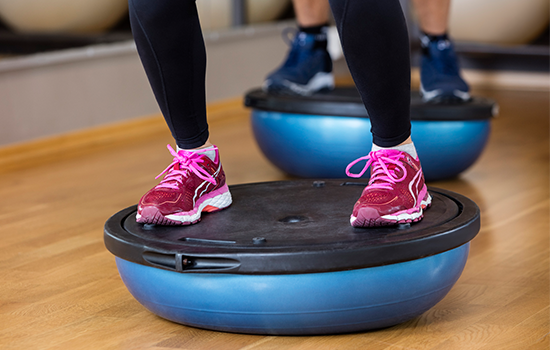
When balance practice is relevant and the setup is suitable, a brief supported dome-up task could be included. Use a secure handhold and a deliberate way to step on and off. Keep the task familiar enough that it does not become the most demanding part of the session.

Follow your model’s instructions. BOSU does not recommend standing on the hard platform side. Rapid jumps, hopping between devices, or maximum-effort holds are not necessary warm-up milestones.

Stretching Is a Separate Decision

A coach can choose appropriate movement preparation or stretching according to the session. Do not force an end position, bounce into discomfort, or use an exaggerated back arch as a default warm-up. Our BOSU flexibility guide compares supported and stable-ground options.

A stretch that feels strong is not necessarily the preparation your next exercise needs. Ask what the movement is intended to accomplish and how it will be adjusted for you.

Use the Warm-Up as a Check-In

Tell the trainer when a familiar movement feels unexpectedly difficult or uncomfortable. That information may change the day’s plan. New pain, dizziness, or unusual symptoms should not be hidden so that you can keep pace with other people.

The warm-up cannot guarantee prevention of injury or provide medical clearance. Persistent or unexplained symptoms need appropriate healthcare advice.

Prepare for Coached Training

Learn how 45-minute semi-private sessions work, or book a Free Body Diagnostic to discuss your starting point. VIP Personal Fitness is downstairs at 1620 Lemoine Ave, Suite 1, Fort Lee.

Your complimentary consultation includes an InBody assessment and discussion of suitable training options, with no obligation to purchase.

V.I.P 1 to 1 Fitness Center is hands down Fort Lee’s best kept secret! About a year ago I felt like I wasn’t able to keep up with my three kids. I knew it was time to make a change both physically and mentally. I contacted Brian Hernandez and have been training with Brian for less than 3 months. The compliments I began receiving about my shape, I had not heard in over a decade. Not to mention, the impact Brian has had on my overall well being is beyond descriptive. I have recommended Brian to 4 of my friends and they are as happy as I am with their results. All that I can say, if you are serious and committed to truly making a positive change, reach out to Brian and find out for yourself. This is the best decision I have ever made!!!!

What Is a BOSU Ball? Uses, Limits, and Getting Started

What Is a BOSU Ball? Uses, Limits, and Getting Started

A BOSU Balance Trainer has an inflated dome attached to a rigid platform. It changes the surface supporting part of your body, creating a different balance or control task from exercising on a stable floor. People often call it a BOSU ball, although it is not a full exercise ball.

Its usefulness depends on the exercise and the person. It is not a necessary purchase for getting fit, a guaranteed way to burn more calories, or a replacement for a complete training plan.

How Is a BOSU Used?

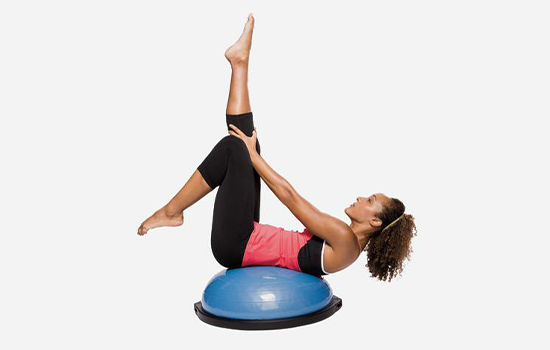
A coach may use an appropriate dome-supported position for balance practice or a selected trunk-control exercise. Different positions change the task. Sitting with both feet supported, placing the forearms on the dome, and standing with secure assistance are not interchangeable exercises.

The manufacturer’s phrase “both sides utilized” should not be interpreted as permission to stand in either orientation. BOSU specifically advises against standing on the hard platform side. Follow the directions for the model you are using rather than copying a social-media demonstration.

What Can It Add to a Workout?

The device can provide variety and a way to practice a chosen balance task. It can also change how a familiar exercise feels. Those are reasons to consider it, not proof that it is better than stable-ground exercise.

For example, a supported dome-up balance task may be chosen deliberately while the main strength exercises remain on stable surfaces. That separates the goals instead of making every movement unstable.

What Are Its Limits?

If balance is the reason you stop an exercise, you may be unable to perform the amount of resistance work you intended. A stable support can be preferable when the main aim is to practice lifting or compare strength over time.

Using a BOSU also requires clear space, suitable support, and a controlled way to get on and off. It is not automatically low risk because it has a soft dome. A device-free exercise can still be the appropriate option for an experienced person.

Our strength-training comparison explains the difference between making an exercise less stable and progressing the strength task.

Before Your First Attempt

Read the model’s instructions, inspect the device, and check the floor and surrounding space. Ask a coach to demonstrate the exercise and its exit. Establish whether a securely fixed handhold is needed; a loose stick or rolling chair is not dependable support.

Begin with a brief, manageable task. Do not add external weights, close your eyes, or increase speed simply to make the first attempt more demanding. Stop and simplify the setup when you cannot remain in control.

Choose an Exercise by Purpose

For balance, start with the concepts in our step-by-step balance guide. For trunk work, compare the supported and stable-ground options in our core-training guide. For conditioning, a suitable walk or stable-ground activity may serve the goal more directly.

There is no requirement to become proficient on a BOSU before lifting weights or joining an appropriate coached workout. The equipment should fit your plan, not become a test you must pass to participate.

When to Seek Individual Advice

Tell your coach about relevant restrictions, current pain, recent surgery, or balance problems. Persistent dizziness or unexplained changes in balance need healthcare assessment. A trainer cannot diagnose the cause from a movement demonstration.

Learn About Coached Training at VIP

Book your Free Body Diagnostic at VIP Personal Fitness, downstairs at 1620 Lemoine Ave, Suite 1, Fort Lee. The complimentary consultation includes an InBody assessment and discussion of your starting point, goals, and training options. There is no purchase obligation.

V.I.P 1 to 1 Fitness Center is hands down Fort Lee’s best kept secret! About a year ago I felt like I wasn’t able to keep up with my three kids. I knew it was time to make a change both physically and mentally. I contacted Brian Hernandez and have been training with Brian for less than 3 months. The compliments I began receiving about my shape, I had not heard in over a decade. Not to mention, the impact Brian has had on my overall well being is beyond descriptive. I have recommended Brian to 4 of my friends and they are as happy as I am with their results. All that I can say, if you are serious and committed to truly making a positive change, reach out to Brian and find out for yourself. This is the best decision I have ever made!!!!