A useful core exercise is one you can perform with the intended movement and an appropriate challenge. A BOSU changes the support surface, but it is not required to strengthen your trunk, and making a plank less stable does not automatically make it better.
The options below are examples to review with a coach. They are not treatment for back pain, a promise of visible abs, or a routine everyone should complete.
Begin With a Stable Reference Exercise
Before changing the surface, practice an appropriate stable version. For example, an elevated plank with hands on a securely fixed support may be easier to manage than a floor plank. Choose a height that allows a comfortable position, keep breathing, and end the attempt before you lose control.
The point is to establish what you can do now. Someone who cannot manage a stable version does not need an unstable one to make the exercise effective.
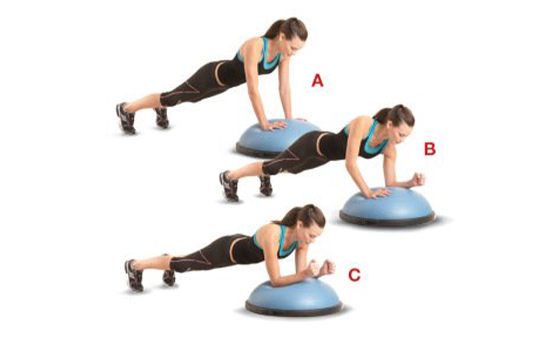
Option 1: A Supported Forearm Plank on the Dome
With the BOSU dome up and the platform on a nonslip floor, a coach may begin with your knees on the floor and forearms supported by the dome. Lean into the position only as far as you can control. Agree on the setup and exit before starting.
A brief controlled hold can be sufficient for practice. Moving to the toes is a separate progression, not a requirement. Do not deliberately rock the device, add a second ball under your feet, or continue until your position collapses.
Option 2: Seated Control With the Feet Supported
When appropriate, sitting on the dome with both feet on the floor can provide a supported balance task. A coach can help you find a comfortable position and decide whether a small weight shift adds anything useful.
Keeping the feet supported is not cheating. Lifting the feet, leaning back, and adding arm movements all change the task. There is no need to combine those changes or turn the exercise into a maximum-duration test.
Option 3: A Stable-Ground Alternative
A suitable side-plank variation, bridge, or controlled arm-and-leg movement on the floor may better match your goal. Your coach can adjust the support, range, and amount of work. A device-free exercise is not an inferior fallback.
For instance, a side-plank variation with bent knees may be worth discussing when a straight-leg version is too demanding. Shoulder comfort, the ability to get down and up, and your relevant medical guidance all affect the choice.
Choose What You Are Measuring
Record the exercise version, surface, assistance, and repetitions or hold duration. A longer hold achieved by changing position is not the same comparison as repeating the original task. Progress may be smoother movement or less unnecessary tension rather than more seconds.
Research on unstable-surface resistance training does not establish that unstable equipment is universally superior. Use the equipment because it serves the task, not because it looks advanced.
Keep Safety and Symptoms Separate From Effort
Follow your model’s instructions. BOSU discourages standing on the hard platform side. Use a clear area and an appropriate way to enter and leave the exercise.
A general plank recommendation cannot determine what is appropriate for someone with back pain, a recent operation, or another medical condition. Stop for pain or dizziness and seek individualized advice for persistent or unexplained symptoms.
Build a Plan Around Your Needs
Compare BOSU and stable-surface strength work, or read our bodyweight-training introduction. Then bring your questions to a Free Body Diagnostic at VIP Personal Fitness.
We are downstairs at 1620 Lemoine Ave, Suite 1, Fort Lee. The complimentary consultation helps discuss fitness goals and coaching options; it is not a medical diagnosis or rehabilitation appointment.