Adding a BOSU to a strength exercise changes the task; it does not automatically improve it. If balance becomes the main limitation, you may be practicing stability while reducing the load or work you can perform. That can be a deliberate choice, but it should be a choice rather than a default upgrade.
This guide helps you discuss the trade-off with a coach at VIP Personal Fitness in Fort Lee. Neither a balance trainer nor a conventional weight is the best tool for every person and goal.
First Ask What the Set Is For
For a strength-focused squat or press, a stable floor, bench, or suitable machine makes it easier to standardize the setup and compare resistance over time. For a balance task, changing the support surface may be part of the intended challenge.
A systematic review of unstable-surface strength training found that outcomes depended on the comparison and population; it did not establish general superiority over stable-surface training. “More unstable” is not a reliable shortcut to “more effective.”
Compare Three Familiar Movements
Squat: on stable ground, a coach can adjust depth, assistance, and resistance for the strength task. A dome-supported version adds a balance demand and may limit the resistance you can manage. Do not infer that using a smaller weight on the dome provides the same strength stimulus.
Press: a suitable stable support lets you focus on the pressing movement and the way you get the weights into position. An unstable support introduces additional setup and control demands. It is not automatically a better choice because it looks more challenging.
Curl or overhead exercise: standing on a balance trainer is not required to train the arms. If your aim is to work the arms through an appropriate range, keep that purpose clear rather than combining tasks that compete for attention.
Use Separate Blocks When the Goals Differ
An illustrative session could include a short supported balance task followed by stable-surface strength work. This allows each task to have its own progression and stopping point. It is not a prescribed VIP session or a requirement to use balance equipment.
Similarly, a trunk-control exercise can be selected separately from the main lifting exercise. You do not need to make every movement train every quality at once.
Keep the Safety Limits Clear
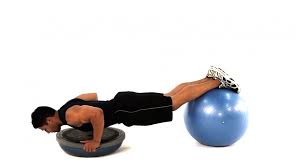
BOSU advises against standing on its hard platform side. Follow the instructions for your model and keep the area clear. This article does not recommend weighted squats or overhead lifting while balancing on that platform.
Do not copy your stable-surface working weight into an unfamiliar unstable setup. Have a coach select an appropriate exercise first, and stop when you cannot control the movement or exit it deliberately. Pain and dizziness are reasons to stop and reassess.
Track Like With Like
Record the exercise, support surface, assistance, resistance, and repetitions. A set performed with a different support is not a direct continuation of the same strength test. Compare the same task under similar conditions before deciding that you became stronger or weaker.
When progression stalls, ask what limited the set: the intended muscles, balance, unfamiliar technique, or discomfort. The answer helps determine whether to keep the movement, simplify it, or use a different tool.
Choose Coaching, Not Equipment Hype
Explore semi-private personal training at VIP Personal Fitness, or discuss our coached group options. Book a Free Body Diagnostic to talk about your goals and starting point.
Find us downstairs at 1620 Lemoine Ave, Suite 1, Fort Lee. The complimentary consultation is separate from ongoing training and is not medical diagnosis or rehabilitation. Individual needs vary.