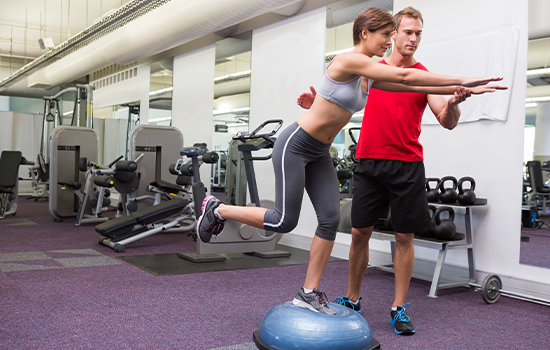
Balance training begins with a task you can control and a dependable way to recover your footing. A BOSU Balance Trainer can be one tool, but you do not have to start on an unstable surface or progress to jumps to make practice worthwhile.
The sequence below is an educational example to discuss with a coach. It is not a fall-prevention assessment or an exercise prescription for someone with a medical balance disorder.
Step 1: Establish a Comfortable Stable-Ground Task
Begin near a securely fixed handhold, on a level, nonslip surface. A coach might first observe a comfortable standing position or a small, controlled shift of weight between the feet. The point is to understand your starting task, not to provoke a loss of balance.
A loose broom, rolling chair, or another unstable object is not reliable support. If standing itself is difficult, seek appropriate assessment rather than moving to more challenging equipment.
Step 2: Check the Equipment and Space
Use the instructions for your BOSU model and check its condition and inflation. Keep the surrounding area clear. The manufacturer does not recommend standing on the platform side. Dome-up use still requires an appropriate task and supervision when needed.
Before stepping on, establish where your support will be and how you will step back onto the floor. Do not add weights, a ball toss, or a closed-eye challenge while learning the setup.
Step 3: Practice a Supported Position
If your coach considers it appropriate, use secure support to practice getting onto and off the dome with both feet. Keep the task brief enough to remain in control. The goal is a repeatable entry and exit, not a record-length hold.
Next, the coach might introduce a small shift of pressure while you retain support. An uncontrolled step off is a reason to simplify the task. It is not evidence that you should try again faster.
Step 4: Progress One Feature at a Time
A progression could be a slightly longer controlled attempt, a modestly smaller amount of hand support, or a different suitable movement. Changing several features together makes the result difficult to interpret.
Standing on one leg is not a compulsory milestone. Nor is turning the device upside down. A stable-ground task may remain the better choice for your goal, and the amount of support you use should not become a competition with another participant.
Step 5: Review What Improved
Record the task, surface, support, and reason the attempt ended. Can you repeat it more confidently under the same conditions? Can you step off deliberately? Those observations are more useful than simply calling the workout harder.
Improvement on one device does not establish that you will avoid falls in daily life or perform a sport better. Review the actual activity you want to improve, and obtain a clinical assessment when balance changes are persistent or unexplained.
Where Strength Training Fits
Balance and strength are related training considerations, but they are not interchangeable. You might practice a supported balance task separately from stable-surface resistance exercises. Read our guide to choosing the training surface for that distinction.
For older adults, CDC activity guidance includes balance activities as well as aerobic and strengthening work. It does not require a BOSU or recommend one exercise for every person.
Ask About an Appropriate Starting Point
Schedule your Free Body Diagnostic at VIP Personal Fitness in Fort Lee to discuss goals, experience, and coaching needs. We are downstairs in Suite 1 at 1620 Lemoine Ave. The consultation is complimentary and carries no purchase obligation; it does not diagnose the cause of balance problems.