Yes, bodyweight exercises can contribute to muscle development when the training is appropriately challenging and progressed over time. The limiting question is not whether a dumbbell is present. It is whether the chosen movement provides suitable work for the muscles you intend to train.
A routine can also become too easy, too difficult, or incomplete. Here is how to review a bodyweight program instead of simply adding more repetitions indefinitely.
What Does the Evidence Show?
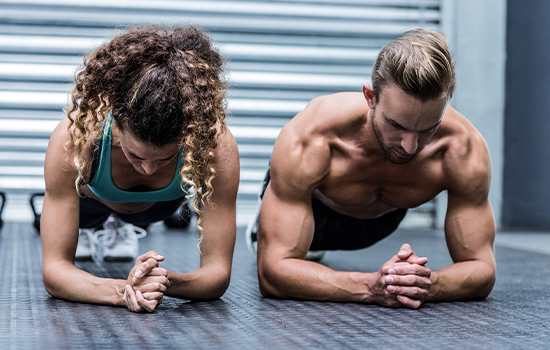
In a small eight-week study of 18 young men, load-matched push-ups and low-load bench presses both increased measured chest and triceps muscle thickness and bench-press strength. The result supports the potential of an appropriately loaded bodyweight exercise; it does not prove that every bodyweight routine works equally well for all people or muscle groups.
Start With a Version You Can Practice
Choose an exercise that fits your current ability and relevant restrictions. An incline push-up, supported split squat, or suitable row can provide a starting task. A pull-up or advanced single-leg squat may be too demanding to practice usefully at first.
Learn the setup and range before turning the movement into a hard set. If you cannot control the first few repetitions, simplify the version or choose a different exercise. Effort and technique should be discussed together, not treated as competing goals.
A Push-Up Progression Example
Suppose you can perform two sets of six controlled incline push-ups on a secure support. Record the support height, repetitions, and how demanding each set felt. The next step might be practicing the same work more consistently, adding an appropriate repetition, or eventually lowering the support.
Do not make all those changes at once. Lowering the support changes the task, so you may need to reduce the repetition target. Two sets of six is an illustration, not a prescription or a promise that you should progress at every appointment.
The comparison is meaningful only when the support, range, and technique are similar. More repetitions achieved by shortening the movement are different information from more repetitions of the original task.
Progress More Than the Repetition Count
Options include changing leverage, adjusting assistance, increasing a suitable range, or adding work when recovery and the program support it. External resistance can also be useful. Bodyweight training does not have to remain equipment-free to be successful.
For example, someone who finds a basic squat easy might benefit from an appropriate loaded squat rather than hundreds of fast repetitions. Another person may be better served by a supported variation while learning control.
Do Not Make Every Set a Failure Test
Agree on a stopping point that fits the exercise and your experience. A beginner learning a movement does not need to keep going until it collapses. The intended challenge should not require ignoring pain, losing a secure grip, or being unable to exit the setup.
Record whether the set ended because the target work was complete, the movement became difficult to control, or something felt uncomfortable. Those are different reasons and may lead to different adjustments.
Check the Whole Program
A routine of push-ups and squats alone does not automatically cover every goal or movement. Consider pulling work, other lower-body tasks, and the rest of your activity. Pulling exercises require a properly installed bar or rated anchor; ordinary furniture should not be treated as training equipment.
Nutrition, sleep, and other demands also belong in the review. More exercise does not guarantee muscle gain when the overall plan is unsuitable. Seek individualized nutrition or medical advice when relevant rather than relying on a generic fitness article.
Get Help Choosing the Next Step
Compare bodyweight work and external weights, or review the starting movements in our beginner guide. Bring your training notes to a Free Body Diagnostic at VIP Personal Fitness.
We are downstairs at 1620 Lemoine Ave, Suite 1, Fort Lee. The complimentary 30-minute consultation includes an InBody assessment and discussion of coaching options. No purchase obligation; individual training needs and results vary.