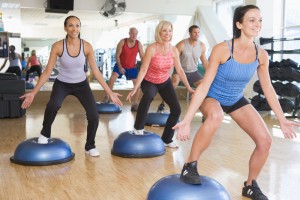
A BOSU can add variety to a workout, but you do not need to move rapidly on an unstable surface to improve your cardiovascular fitness. When balance limits your movement before your intended conditioning effort does, choose a more stable activity rather than forcing the pace.
This guide separates two questions: how to plan a manageable cardio session and when a BOSU task adds something useful. The examples are educational, not a workout prescription for every participant at VIP Personal Fitness.
Decide Whether You Are Training Balance or Conditioning
A deliberate step onto a dome requires different attention from a steady walk. Both can belong in a program, but combining them does not guarantee that you improve both qualities equally.
For a conditioning goal, choose movement that lets you sustain an appropriate effort with control. For a balance goal, allow enough time to position yourself, use support, and step off deliberately. Do not turn a balance drill into a race to keep the heart-rate number high.
A Fifteen-Minute Conditioning Example
One illustrative session uses three minutes of comfortable movement to begin, eight minutes alternating one minute of purposeful movement with one minute at an easier pace, and four minutes gradually easing down. Four work-and-recovery pairs total eight minutes; the complete example totals fifteen.
The purposeful movement could be walking or a suitable stable-ground movement such as marching or side steps. Choose a pace that fits your current ability. Shorten the work periods or extend recovery when needed; completing the clock is not more important than maintaining control.
This is an interval structure, not necessarily high-intensity interval training. Using a timer does not make the effort high intensity, and high intensity is not a requirement for a useful starting session.
Where a BOSU Might Be Included
After a coach has checked the setup, a brief, supported dome-up task might be practiced separately from the conditioning intervals. For example, learning a controlled step on and off with a secure handhold can be treated as skill practice rather than a maximum-speed cardio drill.
Only use a version you can enter and leave deliberately. A stable step or the floor may be a more appropriate choice. Replacing the BOSU is a programming decision, not a failure to complete the workout.
Keep the Equipment Limits Clear
BOSU advises against standing on the hard platform side. Follow the instructions for your model and keep the area clear. This guide does not recommend fast jumps between balance trainers, jumping jacks on an inverted platform, or racing through burpees while losing your footing.
Check that the equipment and floor are not slippery. Stop when fatigue changes your ability to control the task. Adding a pad nearby does not make an uncontrolled fall safe.
Review Effort and Recovery, Not Just Sweat
Write down the activity, work periods, recovery periods, and how the session felt. Were you able to repeat the planned movement? Did you need extra recovery? This gives your coach useful information for the next session.
A watch’s calorie estimate is not a precise measurement of your workout, and no BOSU circuit guarantees a particular amount of fat loss. Progress might mean completing the same appropriate activity more comfortably before changing the workload.
Make the Whole Week Work
Cardio can complement strengthening work rather than replace it. Read our walking and strength-training guide for a weekly planning example, or try the concepts in our bodyweight cardio guide without balance equipment.
New pain, dizziness, or unusual breathing difficulty is a reason to stop and obtain appropriate advice. A fitness article cannot determine the cause or clear you to continue.
Discuss Coached Training in Fort Lee
Book a Free Body Diagnostic at VIP Personal Fitness, downstairs at 1620 Lemoine Ave, Suite 1. The complimentary consultation includes an InBody assessment and a discussion of your goals and suitable training options, with no obligation to purchase.