Getting better at balancing on a BOSU does not automatically improve your golf swing, running speed, or ability to change direction in a game. A sport has specific demands, and a useful conditioning plan needs to explain how an exercise relates to them.
The BOSU may be one accessory in a broader program. It should not replace practicing the sport, developing appropriate strength, or building the conditioning needed to participate.
Separate Four Different Training Jobs
Skill practice develops the actual sporting task, such as striking a ball or controlling a movement in play. Strength work challenges the muscles against an appropriate resistance. Conditioning prepares you for the activity’s effort and duration. Balance practice focuses on controlling a position or movement.
These areas can interact, but an exercise does not train all of them equally just because it is difficult. Ask which job the exercise is supposed to do and how progress will be measured.
What the Research Can—and Cannot—Tell You
A 2015 systematic review found limited additional benefits when unstable-surface training was compared with stable-surface training in healthy adolescents and young adults. Findings differed across outcomes and populations, and study quality was a limitation.
That does not mean balance equipment is useless. It does mean that instability alone is not a reason to promise better athletic performance. A training decision should be tied to the person’s actual task and needs.
A Recreational Golf Example
A golfer who becomes tired while walking a course might discuss a manageable walking and conditioning plan. Someone who wants help with swing technique should work on that skill with an appropriate golf instructor. General resistance exercise may be another part of the broader plan.
A BOSU drill cannot establish which of those needs is most important. Swinging a club while standing on an unstable device also changes the task from swinging on the course. This article does not recommend using that setup as a shortcut to a better swing.
A Field-Sport Example
An athlete may need to practice acceleration, stopping, or changing direction in an appropriate environment. Their coach should consider the athlete’s experience, current workload, season, and any rehabilitation restrictions.
Rapid shuffling across a dome is not automatically a substitute for that practice. Nor does successfully catching a ball while balancing prove that a previous injury is ready for unrestricted play. Return-to-sport decisions require the relevant healthcare and coaching input.
Where a BOSU Could Fit
A coach-selected, controlled balance task could have a limited accessory role when it addresses a specific need. Keep it separate from tasks that demand equipment handling or rapid movement you cannot control. It is reasonable to choose stable-ground balance work instead.
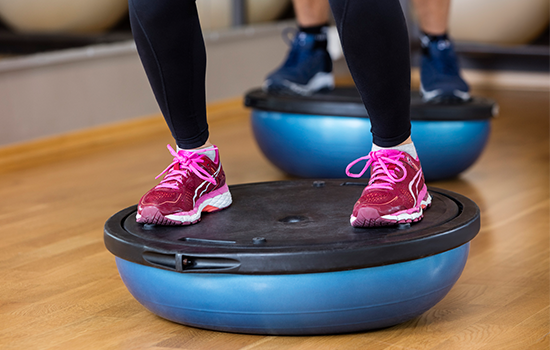
BOSU does not recommend standing on its hard platform side. Follow the product instructions, use an appropriate support, and leave enough clear space. Adding a bat, club, or jumping sequence is not a required progression.
Measure the Goal You Actually Care About
Track the exercise itself, but also review the relevant sporting or everyday activity. Better performance on the dome is evidence about that task—not proof of a faster sprint, a lower golf score, or reduced injury risk.
Agree on a review date and a practical measure with the relevant coach. If the exercise takes time away from a higher-priority need, reconsider its place in the plan. More variety is not always a better use of limited training time.
Connect Fitness Coaching With Your Other Activities
Read BOSU versus stable-surface strength training and our balance-training starting guide. For general fitness support, book a Free Body Diagnostic at VIP Personal Fitness.
We are downstairs at 1620 Lemoine Ave, Suite 1, Fort Lee. The complimentary consultation helps discuss fitness goals and coaching options; it is not medical clearance, rehabilitation, or a guarantee of sport-specific results.